


 All categories
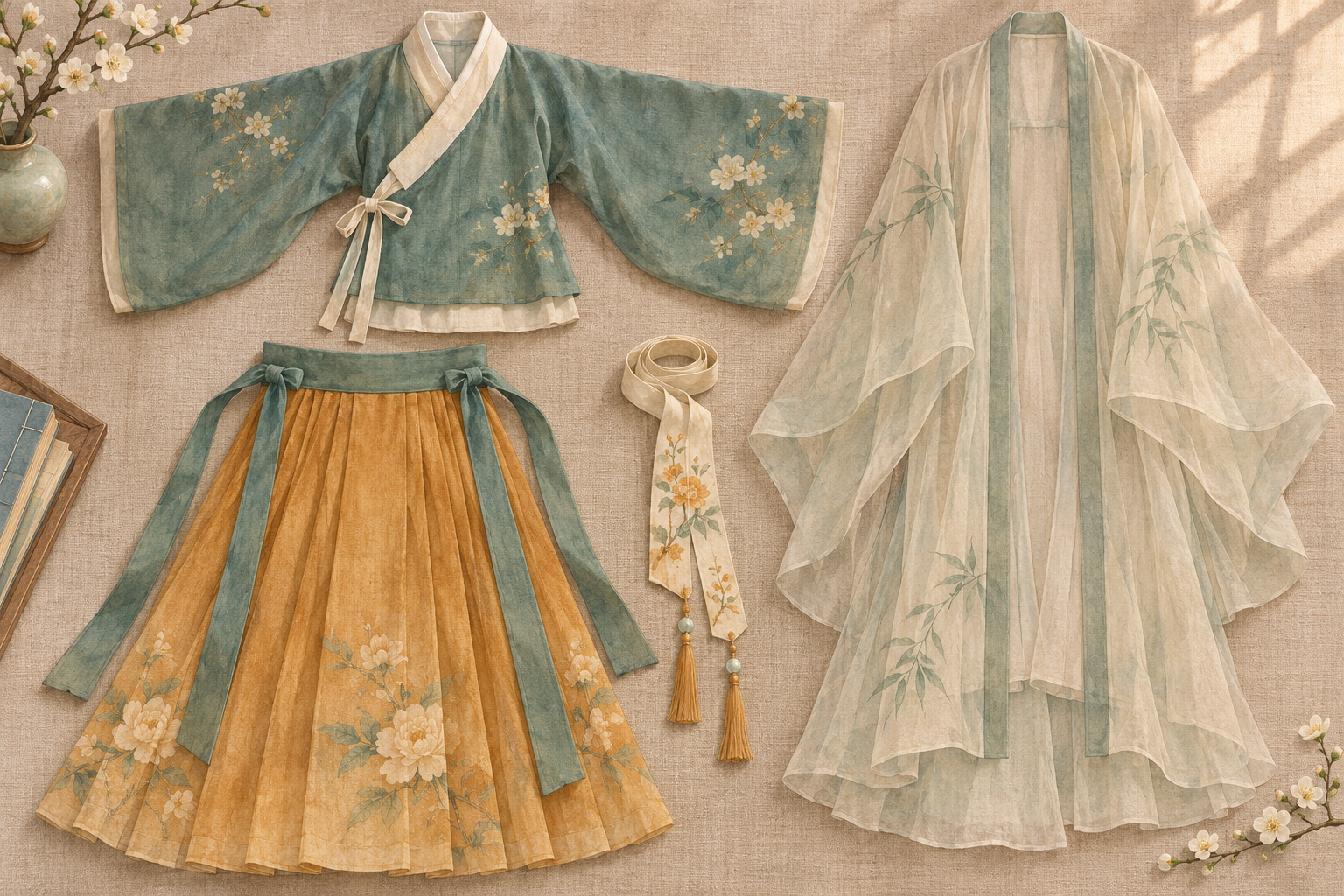
Hanfu is a broad term for clothing associated with Han Chinese dress traditions and their modern revival; it is not a single outfit with a universal parts list. A shop may use the word for a robe, a jacket-and-skirt combination, or a multi-layer set. To understand what you are buying, identify each garment in the photograph and compare it with the “included” list.
The shape, layers, and names can vary across styles. This guide focuses on the questions a first-time wearer can answer from a product page, without suggesting that one modern set represents every historical period.
Start with the main garment, then count the layers
Many hanfu-inspired outfits combine an upper garment with a skirt or trousers. Others center on a longer robe. An outer layer may be added for shape or warmth. Underlayers, belts, and hair accessories may be visible in the styling photograph without being included in the purchase. Before thinking about color, make a simple list of what you can actually see.
| Piece to identify | What it does | Question for the listing |
|---|---|---|
| Upper garment or robe | Provides the main collar and sleeve shape | Is it a separate top, a full-length robe, or an outer layer? |
| Skirt or trousers | Forms the lower half of an outfit | How does the waist close, and what is the finished length? |
| Underlayer | Adds coverage, comfort, or structure | Is it included, and is it needed with this fabric? |
| Outer layer | Changes the silhouette and warmth | Is the coat or sheer layer sold separately? |
| Ties, sash, or accessories | Secure or finish the look | Which ties are attached, and which styling items are optional? |
What “crossed collar” tells you, and what it does not
A crossed collar is a familiar feature in many Chinese dress forms. Look at the actual opening: does the garment wrap across the chest, close with internal ties, or merely print a diagonal line on a modern top? Check the model’s back and side photographs if available. Sleeves can also be wide, narrow, straight, or shaped, and an outer layer may cover the closure of the garment underneath.
A crossed collar alone is not enough to date a garment or prove that it is a faithful reconstruction. Different periods and communities had different dress practices. Museum examples make that variation clear: the British Museum’s exhibition guide on late Qing China distinguishes jackets and skirts worn by Han women from robes worn by Manchu women in that context. It is one historical snapshot, not a template for every outfit sold today.
Two common shopping situations
A separate top and skirt
For a two-piece outfit, you can often adjust the top and lower garment independently. That is useful if your bust and waist fall into different size rows. Ask whether the top is meant to sit inside or outside the waistband, how the skirt ties, and whether there is enough overlap at the back. A mamian skirt, for example, has a distinctive flat-panel and pleated construction, but a photo of the skirt with a blouse does not mean the blouse is part of the set. Read our mamian set checklist for a concrete purchase check.
A robe or multi-layer outfit
A robe may be the main piece, an outer piece, or one layer in a coordinated outfit. A “three-piece” description might count an inner dress, an outer robe, and a sash; another seller might count differently. Ask the seller to enumerate each item by name and show a flat-lay photograph. If the garment is semi-sheer, check whether the required underlayer is in the parcel. If you intend to wear the outfit outdoors, ask how the layers are secured while walking and in wind.
Read a product page like an outfit diagram
- Count the separate garments. Look for a front, back, and flat-lay image rather than relying only on a styled portrait.
- Check the included-item list. Copy it into a note: top, skirt, outer robe, underlayer, belt, hairpiece, shoes.
- Find the size chart for each piece. A single size label may hide different top and skirt measurements. Use the finished garment measurements when provided.
- Measure from your intended wearing position. Skirt length depends on where you tie the waist and the shoes you plan to wear.
- Plan a try-on. Practice the closure, sit, climb a step, and check the back overlap before the event.
Photographs can also show a garment pinned or adjusted for a model. If a tie is hidden, the hem sits differently in two photos, or a collar does not lie flat, ask for a short unedited wearing demonstration. The question is practical: you want to know how the piece behaves without styling tricks.
Historical inspiration and everyday wear can coexist
People wear hanfu for cultural events, photography, celebrations, and ordinary days. Some buyers seek a researched historical silhouette; others choose a contemporary interpretation. Neither goal is clarified by the word “hanfu” alone. A good listing should describe the specific style, fabric, components, and changes made for modern wear. For historical context, the Met’s early twentieth-century wedding jacket and skirt shows one documented outfit whose pieces and influences can be examined rather than guessed from a trend label.
If you want a small first step, a separate skirt may be easier to fit and combine with your wardrobe than a multi-layer ensemble. If you want to learn a full dress form, take the time to identify the particular garments and how they work together. Our comparison of hanfu, qipao, and Chinese-inspired fashion can help you choose a starting category.
Frequently asked questions
Does a hanfu listing always include everything in the photo?
No. Clothing, accessories, shoes, and underlayers are often styled together but sold separately. Rely on the included-item list, and request clarification when it is vague.
Do I need a special petticoat?
It depends on the fabric, opacity, skirt construction, and silhouette you want. Check whether the garment is see-through in daylight and whether an underlayer is shown or included. Do not assume every outfit needs the same one.
Can I mix sizes in a set?
Some sellers allow it and some do not. Ask for separate finished measurements for the top and bottom, then confirm whether you can order different sizes before paying.

