All categories
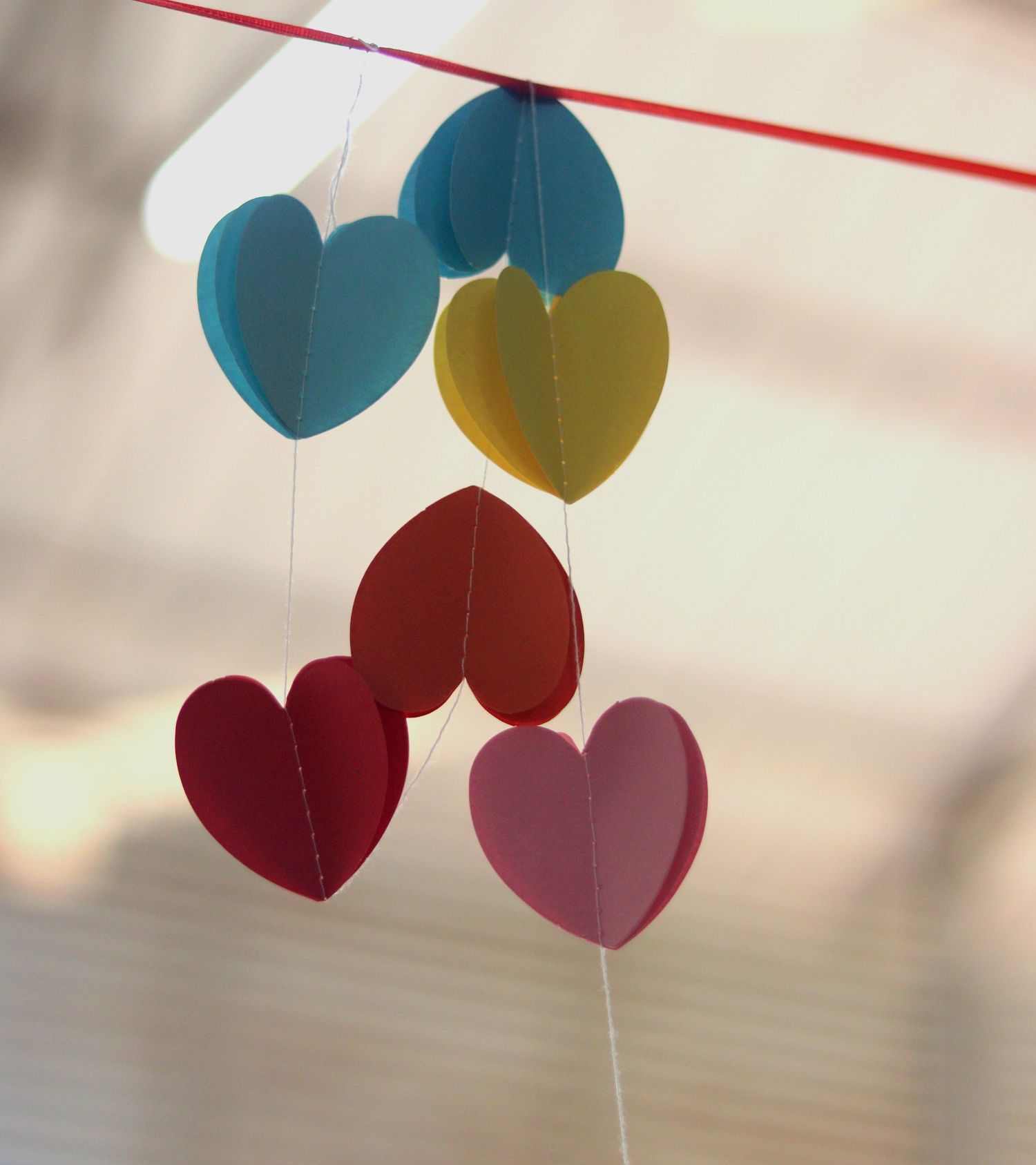
Cover photograph: B M Rauf / Pexels, Pexels License. Editorial photograph; pictured items are not Thread & Fest products.
A heart garland is a simple way to mark Valentine’s Day at home, at a small gathering or in a shop window. The challenge is scale: the garland that looks full across a narrow mantel may look sparse over a wide doorway. A listing may give the length of the cord but not the size or number of hearts.
The cover photograph shows real paper hearts in several colours suspended on strings. It illustrates the effect of spacing and vertical drop; the pictured decoration is not a Thread & Fest product.
Measure the actual display line
Decide whether the garland will hang straight, drape in a shallow curve or drop vertically. Measure the path it will follow rather than only the width of the wall. A curved drape needs more length than a straight line. Leave extra cord for tying or attaching the ends, especially if you want the decoration to sit below the hooks.
For a mantel, make sure the garland does not cover a working control or hang near a source of heat. For a window, check blinds and how the window opens. For a doorway, leave headroom and avoid loose strands that can catch on people or bags. A dry run with string gives you a better buying measurement than guessing from a styled photograph.
Compare heart size and spacing
The cord length alone does not tell you how full the display will look. Look for the number of hearts, their height and the gap between them. A long cord with a few small hearts can appear sparse; a shorter garland with larger shapes can feel more substantial. If the seller has no photo of the item hung in a real space, sketch the positions on paper or mark them with small pieces of tape.
Choose a viewing distance. Tiny details are pleasant on a dining table but disappear across a room. For a compact home, one garland at eye level often has more impact than several scattered strings.
Paper, felt or other fabric?
Paper is lightweight and can fold flat, but it may crease or tear when taken down. Felt and other fabric can be softer and easier to store, though they may collect dust and need more space. Check the attachment points and how the hearts are joined to the string; that detail affects whether a piece will survive another season.
If you want to reuse the garland, favour a design without a printed year or a message tied to one specific event. A simple heart shape can work for an anniversary or another family celebration. The colour need not be only red and pink: choose a palette that suits the room and the people using it.
Think about the whole room
Decide whether the garland is the focal point or a supporting accent. If a gift table already has flowers, cards and wrapped packages, a quiet garland may be enough. If the wall is otherwise plain, a larger or layered display can provide the visual focus.
Keep lighting in mind. Paper hearts backlit by a bright window may look darker from inside, while a garland against a busy patterned wall can disappear. Take a test photo from the main viewing angle before adding more decorations. You may only need to move the garland rather than buy another one.
Store it without a tangle
Remove the string gently, straighten it and wrap it around a piece of card or a small reel. Put delicate paper hearts between sheets of clean paper. Label the package with its finished hanging length and the spot where it worked. That makes reuse easy and helps you compare a future garland with one you already own.
Before ordering, check cord length, number and size of hearts, material, attachment method and indoor/outdoor suitability. Those five details answer most of the practical questions that a styled image cannot. For other celebrations that may use the same reusable garland, browse our festival calendar.
Sources and further reading
- A Reddit discussion on simple Valentine decorations includes paper hearts and homemade garlands, showing how much effect a small amount of material can have.
- Hobbycraft’s occasion ideas illustrate the difference between a craft project and a finished decoration a shopper may need.